Explore Kolkata’s Bonedi Bari Durga Pujas Guide
By kuhook | Kolkata Heritage Trail
Kolkata’s Durga Puja is much more than a festival of grand pandals and artistic installations. Behind the city’s famous celebrations lies another tradition: Bonedi Bari Durga Puja, the ancestral family worship of Goddess Durga, preserved through generations in historic mansions, courtyards and traditional thakur dalans.
These family pujas offer a glimpse into Kolkata’s social history, architecture, religious practices and artistic heritage. Some are known for their distinctive idols, others for unusual rituals, and many for the stories associated with the families who established them.
1. Shobhabazar, Bagbazar and Kumartuli
01. Shobhabazar Rajbari — Boro and Chhoto Rajbari
Location: 33 and 36 Raja Nabakrishna Street, Shobhabazar, Kolkata – 700005
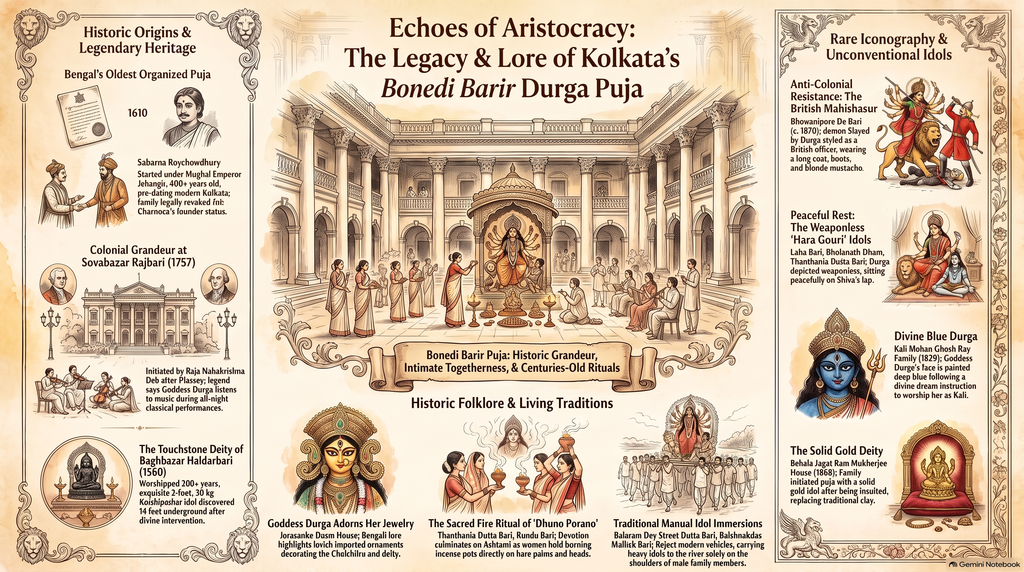
The Shobhabazar Rajbari Durga Puja is among Kolkata’s best-known aristocratic family celebrations. The puja is traditionally associated with Raja Nabakrishna Deb and is reported to have begun in 1757. The historic thakur dalan, the mansion’s architectural character and its association with music and cultural gatherings make it an important part of the city’s heritage.
02. Bagbazar Haldar Bari
Location: 17/1 Kaliprasad Chakraborty Street, Kolkata – 700003
Haldar Bari is noted for its distinctive touchstone Mahishasuramardini idol. The sculpture and the family’s traditional worship offer an opportunity to explore a different artistic expression of Goddess Durga beyond the familiar contemporary clay image.
03. Abhay Charan Mitra Bari
Location: Kumartuli; exact address requires local confirmation
Abhay Charan Mitra Bari appears in historical accounts of Kolkata’s Bonedi Bari pujas. The published account by Amitabha Gupta states that this family puja had stopped by the time of his writing. It is therefore included here as a historical heritage reference, not as a confirmed current visitor destination.
04. Kabiraj Ganga Prasad Sen Family Puja
Location: 17 Kumartuli Street, Kolkata – 700005
This family puja is reported to date to 1840. One distinctive feature mentioned in the source is the unusual arrangement of the deities Ganesh and Kartik. Its location in Kumartuli also places it within one of Kolkata’s most important traditional neighbourhoods for sculptors and image-makers.
05. Adharlal Sen Bari
Location: 97A and 97B Beniatola Street, Kolkata – 700005
Adharlal Sen Bari is associated with the cultural and spiritual history of nineteenth-century Kolkata. The published account connects the household with Sri Ramakrishna and describes two household pujas within the divided property. Visitors should confirm which premises, if any, are open during the festival.
2. Jorasanko, Pathuriaghata and North Kolkata
06. Shib Krishna Daw (Dawn) Bari
Location: 12A Shibkrishna Dawn Lane, Kolkata – 700007
The Shib Krishna Daw family puja is reported to have begun in 1840. The household is noted for its decorated chalchitra and traditional jewellery associated with the idol. It is one of the historic family pujas remembered in local accounts of Kolkata’s old festive culture.
07. Narasingha Daw Bari — Gunmakers’ Puja
Location: 20 Vivekananda Road, Kolkata – 700006
The Narasingha Daw family puja is reported to date to 1859. The source describes a cannon-related ritual associated with Sandhi Puja, making it a distinctive example of the varied traditions maintained by Kolkata’s old families. The details and public accessibility of the ritual should be checked locally.
08. Pathuriaghata Khelat Ghosh Bari
Location: 47 Pathuriaghata Street, Kolkata – 700006
Khelat Ghosh Bari is associated with a grand thakur dalan, a long marble corridor, chandeliers and a historic performance hall. The architecture reflects the cultural aspirations of Kolkata’s wealthy nineteenth-century households, where religious celebrations often existed alongside music, theatre and social gatherings.
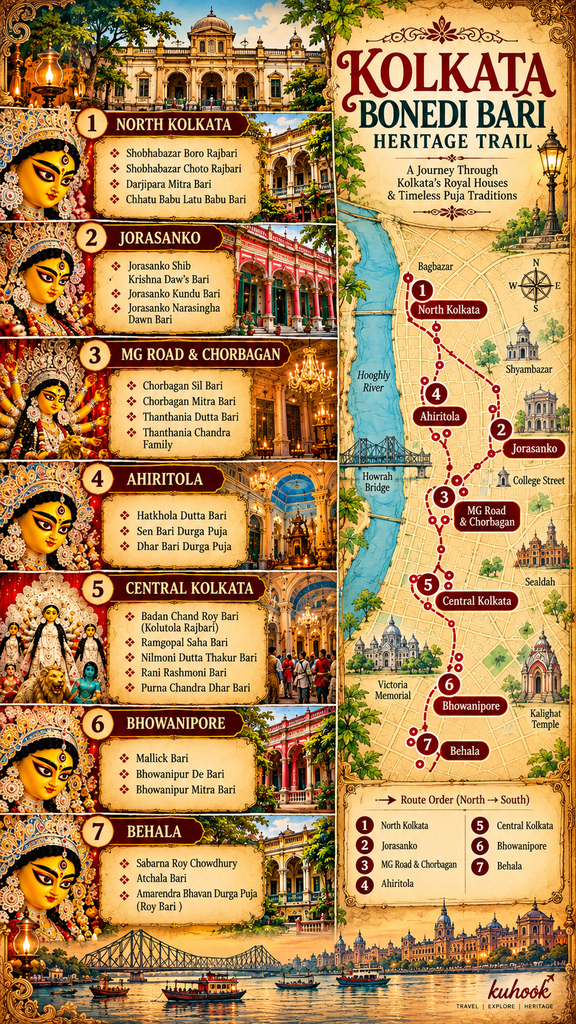
09. Chhatu Babu–Latu Babu Bari
Location: Ramdulal Nibas, 67E Beadon Street, Kolkata – 700006
The family puja is reported to have started in 1770 under Ram Dulal Dey, whose sons became popularly known as Chhatu Babu and Latu Babu. The idol’s Jaya and Bijaya figures are among the features noted in the published account. The household represents the long connection between Bengal’s merchant families and the city’s festive traditions.
10. Darjipara Mitra Bari
Location: 19 Nilmani Mitra Street; another premises is listed at 42 Beadon Row, North Kolkata
Darjipara Mitra Bari is known for its historic family worship and traditional setting. The source mentions an old throne and a Muttchouri backdrop. Different passages in the source give slightly different dates for the origin of the puja, so the exact founding year should be treated cautiously.
11. Madan Mohan Dutta Bari
Location: 2 Dutta Para Lane, Kolkata – 700006
Madan Mohan Dutta Bari is another historic family puja associated with the business and social history of old Kolkata. As with many ancestral celebrations, the value of the household lies not only in the annual worship but also in its connection with the neighbourhood’s changing urban landscape.
12. Haatkhola Dutta Bari
Location: 78 Nimtala Ghat Street, Kolkata – 700006
The Haatkhola Dutta family puja is reported to date to 1794. The source describes traditional clay-made sari and ornaments, along with a khirer putul ritual. These details illustrate how family pujas can preserve distinctive artistic and ritual practices alongside the more familiar forms of Durga worship.
13. Bholanath Dutta Bari — Bholanath Dham
Location: 33/2 Beadon Street, also known as Abhedananda Road, Kolkata – 700006
Bholanath Dham is particularly notable for its Hara-Gouri form of Durga, in which the Goddess is depicted seated on Shiva’s lap rather than in the familiar Mahishasuramardini composition. The published account also mentions Kumari Puja and Dhuno Porano. Its iconography makes it one of the more distinctive household traditions in the city.
14. Baishnab Das Mallick Bari
Location: 32 Darpanarayan Tagore Street, Kolkata – 700006
The Baishnab Das Mallick family puja is known for a distinctive iconographic arrangement: the Goddess is described as seated on Shiva’s lap, with Jaya and Bijaya appearing in place of Lakshmi and Saraswati. This form offers a striking example of the diversity of Durga imagery found in Bengal’s traditional family worship.
15. Mallick Bari — Singha Bahini Puja
Location: 39 Jatindra Mohan Avenue, Kolkata
The Singha Bahini Puja is associated with an old ashtadhatu idol. The source notes that the idol may be hosted at different family branches in different years. Because of this rotating tradition, visitors should confirm the current year’s venue before planning a visit.
16. Chorbagan Chatterjee Bari
Location: 120 Muktaram Babu Street, Kolkata – 700007
Chorbagan Chatterjee Bari is reported to have a family puja dating to around 1860. The source also mentions the household’s association with theatre history. Its location in the old neighbourhood of Chorbagan makes it part of a wider cluster of historic family homes.
17. Chorbagan Mitra Bari
Location: 84 Muktaram Babu Street, Kolkata – 700007
Chorbagan Mitra Bari is noted for its grand old mansion and architectural details described as Gothic-influenced. Like several neighbouring family pujas, it represents the preservation of a private religious tradition within the historic built fabric of North Kolkata.
18. Chorbagan Seal Bari
Location: 42 Muktaram Babu Street, Kolkata – 700007
The Seal family puja is described in the source as more than 150 years old. It is a reminder that the lanes of old Kolkata contain many household celebrations that may be less widely known than the city’s major public pandals but remain important to local family and neighbourhood histories.
19. Laha Family Bari
Locations of family branches listed in the source:
- 2A Bidhan Sarani
- 121 Muktaram Babu Street
- 50A Kailash Bose Street
- 1 Bechu Chatterjee Street
The Laha family’s Durga Puja is reported to be more than two centuries old. The source describes a Hara-Gouri form of the idol and notes that the celebration may move between different family residences. Because these are separate branches, visitors should verify the relevant household and venue for the current year.
20. Balaram Dey Street Dutta Bari
Location: 159 Balaram Dey Street, Kolkata – 700006
The puja is reported to date to 1882. The source mentions Kumari Puja, Dhuno Porano and an immersion tradition in which the idol is carried on bamboo poles. These customs distinguish the household’s celebration from more familiar processions and rituals.
3. Thanthania, Jhamapukur, Maniktala and Central-North Kolkata
21. Purna Chandra Dhar Bari
Location: 32A Debendra Mullick Road, North Kolkata
Purna Chandra Dhar Bari is noted for its Abhaya Durga form. Instead of the familiar ten-armed image slaying Mahishasura, the Goddess is described as having two hands. The distinctive iconography makes this household particularly interesting for visitors who appreciate the diversity of traditional Durga sculpture.
22. Jhamapukur Chandra Bari
Location: 24A Bechu Chatterjee Street, Kolkata – 700009
The Chandra family puja is reported to have begun at Jorasanko in 1761 and to have moved to Jhamapukur in 1870. Its idol is described as Hara-Gouri, showing the Goddess in association with Shiva. The household is an important example of a family tradition that changed location while preserving its distinctive form of worship.
23. Badan Chandra Roy Bari — Kolutolla Rajbari
Location: 2A Gopal Chandra Lane, Colootola, Kolkata – 700073
The puja is reported to date to around 1857. The house is described as a substantial historic residence with a large thakur dalan, white pillars and traditional daker saaj. Its courtyard and architecture offer a glimpse into the domestic spaces in which old Kolkata’s family pujas are celebrated.
24. Ramgopal Saha Bari
Location: 4 Thakurdas Palit Lane, Kolkata – 700012
Ramgopal Saha Bari is described as having a decorated thakur dalan and a family puja more than 175 years old. The household adds to the rich heritage of central-north Kolkata, where historic residences and narrow lanes preserve traces of the city’s older social life.
25. Maniktala Saha Bari
Location: 122A Maniktala Street, Kolkata – 700006
The Maniktala Saha family puja is described as around 150 years old. Its large courtyard and decorated thakur dalan are notable features. The household’s history is linked with the merchant communities that helped shape the commercial and residential life of old Kolkata.
26. Ghose Bari, Ghose Lane
Location: 4 Ghose Lane, Maniktala, Kolkata – 700006
The family puja is reported to date to 1856. One unusual tradition mentioned in the source is the performance of Kalyani Puja instead of the customary Sandhi Puja. As rituals can change over time, visitors should treat this as a source-reported tradition rather than a guarantee of the current year’s observance.
27. Thanthania Dutta Bari
Location: 3 Bidhan Sarani, near Thanthania Kali Bari, Kolkata – 700006
Thanthania Dutta Bari is associated with a Hara-Gouri form of Durga and the ritual of Dhuno Porano. It sits within an area rich in historic religious landmarks, making the surrounding neighbourhood a useful place to explore on a heritage walk.
28. Pataldanga Basu Mallick Bari
Location: 18 and 22 Radhanath Mallick Lane, Kolkata – 700012
The family puja is reported to have begun in 1831. The source highlights cast-iron framing, Dasavatar depictions and a ritual called Kadamati Khela. These architectural and ritual details help distinguish the household from other family pujas in the surrounding area.
29. Mahendra Sreemany Bari
Location: 17 Mahendra Srimani Street, also known as Sukea Street, Kolkata – 700009
Mahendra Sreemany Bari is known for its thakur dalan and traditional daker saaj. The published account places the family’s residence in the context of the late nineteenth and early twentieth centuries. The household is a useful stop for visitors interested in both traditional idol decoration and the architecture of old Kolkata.
30. Nilmani Sen Bari
Location: 130 Baithakkhana Road, Kolkata – 700009
Nilmani Sen Bari is known for its Abhaya Durga, described as a two-handed form rather than the usual ten-armed Mahishasuramardini. The source also mentions a ritual involving 108 lamps. As with all household customs, current observance and visitor access should be confirmed in advance.
31. Shambhunath Sen Bari
Location: 3 Rammohan Ray Sarani, also known as Amherst Street, Kolkata – 700009
The puja is reported to date to 1923. The idol follows an ekchala design, in which the principal deities are arranged within a unified backdrop. The household is another example of how traditional family pujas retain distinctive visual styles within the wider culture of Bengali Durga worship.
32. Patuatola Banerjee Bari
Location: Durga Bari, 8 Patuatola Lane, Kolkata – 700009
The family puja is reported to date to 1890. The source mentions family-prepared bhog and an older tradition of musical gatherings. Its location within the historic street network of North Kolkata makes it a possible addition to a neighbourhood-based heritage walk, subject to access.
33. Harinath Mookerjee Bari
Location: 4 Kalidas Singha Lane, Kolkata – 700009, behind Rajabazar Science College
The source dates this family puja to 1722 and connects its history with the family’s move to Kolkata. It is a reminder that many of the city’s older Durga Pujas originated in family histories that extend beyond the present boundaries of the metropolis.
4. Central Kolkata and Bowbazar
34. Rani Rashmoni Family Puja
Location: Rani Rashmoni Road / S. N. Banerjee Road area; verify the exact entrance locally
The family puja is associated with Rani Rashmoni, one of nineteenth-century Bengal’s most prominent historical figures. The source also mentions a connection with Sri Ramakrishna. Because the location description is broad, visitors should confirm the precise household and entrance before setting out.
35. Chandra Family Bari
Location: 23 Nirmal Chandra Street, Central Kolkata; verify locally
The source describes a grand courtyard and a historic family puja at this address. More detailed historical information should be confirmed locally before publication as a definitive account. This entry is included as part of the combined heritage directory.
36. Dutta Family Bari — Hidaram Banerjee Lane
Location: 62 Hidaram Banerjee Lane, Kolkata – 700012
The published guide dates this family puja to 1883. It is important not to confuse this household with other Dutta family pujas in Haatkhola or Balaram Dey Street: they are treated as separate family branches because their locations differ.
37. Biswanath Motilal Family Puja
Location: 1/C Durga Pithuri Lane, Central Kolkata
Biswanath Motilal’s family puja is listed among the historic celebrations in the Bowbazar area. The exact address and historical details should be checked locally, as the available descriptions are limited.
5. Bhawanipur and South Kolkata
38. Bhawanipur Mitra Bari
Location: 13 Paddapukur Road, Bhawanipur, South Kolkata
The puja is reported to date to 1757. Its most distinctive feature is the unusual Abhaya-style Durga idol. Although the Goddess appears to have two hands at first glance, the source describes additional short arms partly concealed by the decoration. This makes the household particularly notable for devotees and visitors interested in iconography.
39. Bhawanipur De Bari
Location: 26/E Chandra Nath Chatterjee Street, Kolkata – 700025
The family puja is reported to date to 1870. The published account recounts a family legend associated with its origin. As with other ancestral celebrations, the household’s history is part of the living heritage of South Kolkata.
6. Behala, Barisha and Khidderpore
40. Sabarna Roy Chowdhury Aatchala Puja
Location: 26 Sabarna Para Road, Barisha, Kolkata – 700008
The Aatchala Puja of the Sabarna Roy Chowdhury family is traditionally dated to 1610 and is often described as one of Bengal’s oldest family Durga Pujas. The wider family has several branches and pujas. The Aatchala celebration is especially important for understanding the early history of Kolkata and the religious traditions of Barisha.
41. Behala Jagat Ram Mukherjee Bari — Sonar Durga
Location: 56 Bramho Samaj Road, Behala, Kolkata – 700034
This household is known for its Sonar Durga, or golden Durga image, which the source says was introduced in 1869. The golden appearance makes it one of the distinctive family pujas associated with Behala.
42. Behala Roy Family Puja — Amarendra Bhavan
Location: 4/1 Roy Bahadur A. C. Roy Road, Behala, Kolkata – 700034
The Behala Roy family puja takes place at Amarendra Bhavan, described in the source as a white-marble mansion. The family’s puja is reported to date to 1756. The residence and its traditional setting make this an important heritage reference for visitors exploring the southern reaches of Kolkata.
43. Bhukailash Rajbari
Location: Kanchan Colony, Babu Bazar, Khidderpore, Kolkata – 700023
Bhukailash Rajbari is a historic royal complex associated with Raja Jaynarayan Ghoshal and known for its Shiva temples. It is included in this guide as a heritage site connected with the religious and architectural history of the Khidderpore area. Confirm the status and public access of any Durga Puja celebration before visiting.
Distinctive Durga Forms and Rituals to Look For
One of the most fascinating aspects of Bonedi Bari Durga Puja is that the Goddess does not appear in exactly the same form in every household. The source articles describe several distinctive traditions:
- Sonar Durga: The golden Durga image associated with Jagat Ram Mukherjee Bari in Behala.
- Abhaya Durga: A distinctive two-handed form described at Purna Chandra Dhar Bari and Nilmani Sen Bari.
- Hara-Gouri: A form associated with Shiva, described at households including Bholanath Dham, Laha Bari, Thanthania Dutta Bari, Jhamapukur Chandra Bari and Baishnab Das Mallick Bari.
- Traditional decoration: Daker saaj, elaborate chalchitra, old ornaments and distinctive backdrops feature in accounts of several family pujas.
- Household rituals: Kumari Puja, Dhuno Porano and special immersion customs are mentioned in the source articles. Their observance and availability for visitors can vary.
These traditions are among the reasons Bonedi Bari pujas deserve to be explored as a form of living cultural heritage, rather than simply as sightseeing stops.
Tips for Visiting Kolkata’s Bonedi Bari Pujas
1. Check access before visiting. Many celebrations take place inside private homes. A listing in a travel article does not guarantee that visitors will be admitted.
2. Verify addresses and schedules. Some old street names have changed, and multiple branches of a family may hold pujas at different locations. Confirm the current venue and timings before travelling.
3. Ask before taking photographs. Respect the privacy of residents and worshippers. Always seek permission before photographing idols, family members or interiors.
4. Dress respectfully. Follow the household’s instructions regarding footwear, entry and restricted ritual areas.
5. Do not assume bhog is available. Food distribution is not guaranteed for visitors. Ask the household in advance rather than expecting to participate.
6. Plan by neighbourhood. Group nearby households together to reduce unnecessary travel through congested streets. Allow extra time during the festival.
Final Thoughts
Kolkata’s Bonedi Bari Durga Puja tradition is a journey through the city’s layered history. From the celebrated Shobhabazar Rajbari to the distinctive family pujas of Jorasanko, Chorbagan, Thanthania, Bhawanipur, Behala and Barisha, each household offers a different perspective on devotion, art, architecture and family heritage.
The value of these celebrations lies not only in their reported age, but in the traditions that families continue to preserve. A visit can reveal a rare idol form, an old courtyard, an inherited ritual or simply the intimate atmosphere of worship within an ancestral home.
For heritage travellers, the best approach is to move thoughtfully, respect the privacy of residents and treat every household as a living place of worship—not merely a tourist attraction.
Explore Kolkata’s living heritage with kuhook.
Sources and Further Reading
- Amitabha Gupta — “Durga Puja of ‘Bonedi’ Families at Kolkata”
https://amitabhagupta.wordpress.com/2013/10/08/durga-puja-of-bonedi-families-at-kolkata/ - Tale of Two Backpackers — “Bonedi Bari Durga Puja in Kolkata”
https://taleof2backpackers.com/bonedi-bari-durga-puja-in-kolkata/
Editorial note: This article consolidates overlapping household names from the two sources. Historical dates, ritual descriptions and addresses reflect those published accounts and have not all been independently verified. The list is a starting point for heritage exploration, not a guarantee that every puja is currently active or open to the public.